
Key numbers
Date last updated: 20 May 2026 05:52 (MST)
This page is intended as a quick reference list of key numbers that describe the Rubin Observatory system and the Legacy Survey of Space and Time (LSST).
See also the Rubin key numbers page for a public audience.
Telescope
- Etendue (AΩ): 319 m2 deg2
- Field of View (FOV): 3.5 deg (9.6 deg2)
- Primary mirror diameter: 8.4 m
- Mean effective aperture: 6.49 m (area weighted over FOV)
- Final f-ratio: f/1.233
- Camera weight: 6,746 lbs (3,060 kg)
- Mirror (M1+M3 glass mirror only) weight: 35,900 lbs (16,284 kg)
- Expected median slew time between visits: 4.8 s
Camera
- Pixel count: 3.2 Gpixels
- Focal plane: 189 4k x 4k science CCD chips
- Pixel scale: 0.2 arcsec/pixel
- Pixel size: 10 microns
- Filling factor: >90%
- Minimum exposure time: 1 s
Filters
The 5-sigma point source depths (AB mag) for single exposures and for coadded images idealized for stationary sources after 10 years (PSTN-054) are:
- u: 23.8, 25.6 mag
- g: 24.5, 26.9 mag
- r: 24.0, 26.9 mag
- i: 23.4, 26.4 mag
- z: 22.7, 25.6 mag
- y: 22.0, 24.8 mag
Visit GitHub to download the spectral response and throughputs.
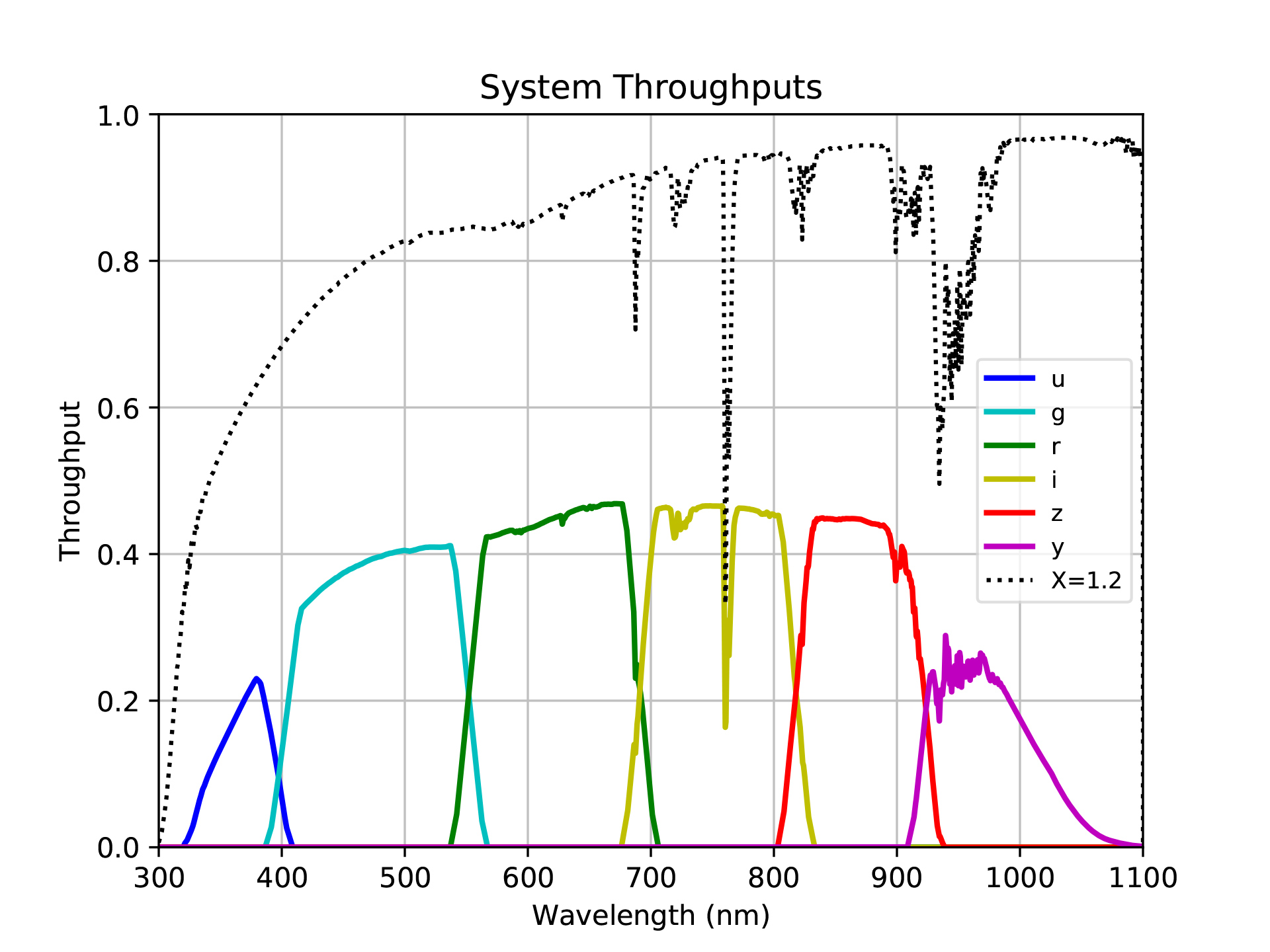
Above: The Rubin Observatory bandpasses. The vertical axis shows the total throughput. The computation includes the atmospheric transmission (assuming an airmass of 1.2, dotted line), optics, and the detector sensitivity. For more details, please see the LSST overview paper.
Observatory site
- Median Atmospheric PSF with outer scale of 30m: 0.67” (Tokovinin)
- Site: El Penon, Cerro Pachon, Chile
- Site coordinates: latitude -30:14:40.68, longitude -70:44:57.90
- Altitude: 2647 m
- Site observatory code: X05
- Photometric time: 53% of night time (estimated)
Survey
- Survey duration: 10 years
- Fiducial number of visits per pointing (main survey): 800
- Fiducial main survey area: 18,000 deg2
- Estimated total covered area (including special programs): 25,000 deg2
- Standard visit exposures (expected): 30 s
- Time to take a single exposure: 34 s
- Median (Mean) visit time (normal survey mode): 36 s (41 s)
Learn more about the Legacy Survey of Space and Time (LSST).
Data volume
- Nightly data size: 10 TB/night
- Real-time alert latency: 60 s
- Alerts per visit: ~10,000
- Alerts per night: ~10 million
- Number of data releases: 11
- Final database size (DR11): 15 PB
- Final number of objects (DR11):
- 20B galaxies
- 17B resolved stars
- 6M orbits of solar system bodies
Operational performance
Accuracy specifications:
- Photometric accuracy: 10 mmag
- Astrometric accuracy: 50 mas
- Astrometric precision: 10 mas
- Observing nights per year: ~300
- Number of visits per night: 700 (average)
- Number of calibration exposures: 450/day
- Number of visits collected over 10 years: 2.1M
- Number of images collected over 10 years: ~2.1M
Alerts
- Real-time alert latency: 60 s
- Alerts per visit: ~10,000
- Alerts per night: ~7 M
- Potential total alerts in 10 years: 20 B
Number of objects
- Estimated numbers for DR1 release:
- Objects: 18 B
- Sources: 350 B
- Forced Sources: 0.75 T
- Estimated number of objects (DR11): 37 B
- 20 B galaxies
- 17 B resolved stars
- 6 M orbits of solar system bodies
- Estimated number of single-epoch sources (DR11): 7 T
- Estimated number of forced measurements (DR11): 30 T
Didn't find what you're looking for?
Find more information in Rubin's technical documentation for scientists.
Glossary and Acronyms
Look up Rubin-related terms and acronyms in English and Spanish.
Rubin Community Forum
Ask questions, get help, report bugs or errors, and join in discussions about Rubin Observatory and its data products, pipelines, and services.